

Phenotypic Detection of AmpC β-Lactamase Using Disc Approximation Test: can they be used routinely?
Introduction
AmpC β-lactamases pose a significant clinical challenge by hydrolyzing penicillins, cephalosporins (e.g., ceftazidime), and cephamycins (e.g., cefoxitin). If undetected, they lead to:
- Inappropriate treatment: Initial susceptibility testing may falsely classify AmpC-producing isolates as sensitive to expanded-spectrum cephalosporins.
- Clinical failure: Resistance can emerge during therapy, resulting in treatment failure, sepsis progression, or increased mortality.
Routine detection of AmpC is critical because it:
- Prevents misguided antibiotic regimens (e.g., cephalosporin use in AmpC producers).
- Guides targeted antimicrobial therapy, avoiding ineffective drugs.
- Supports infection control measures (e.g., isolating plasmid-mediated AmpC carriers).
Promotes antimicrobial stewardship by reducing unnecessary carbapenem use.
Practical, low-cost phenotypic tests (e.g., disc approximation) with strong sensitivity and specificity are essential for reliable detection in clinical laboratories.
Analysis of Resistance in the Plates
Test Principle
Ceftazidime (CAZ) disc placed centrally with inducer discs (imipenem/IPM, cefoxitin/FOX, amoxicillin-clavulanate/AMC, piperacillin-tazobactam/TZP) placed radially. Flattening/indentation of the CAZ inhibition zone toward an inducer indicates AmpC production.
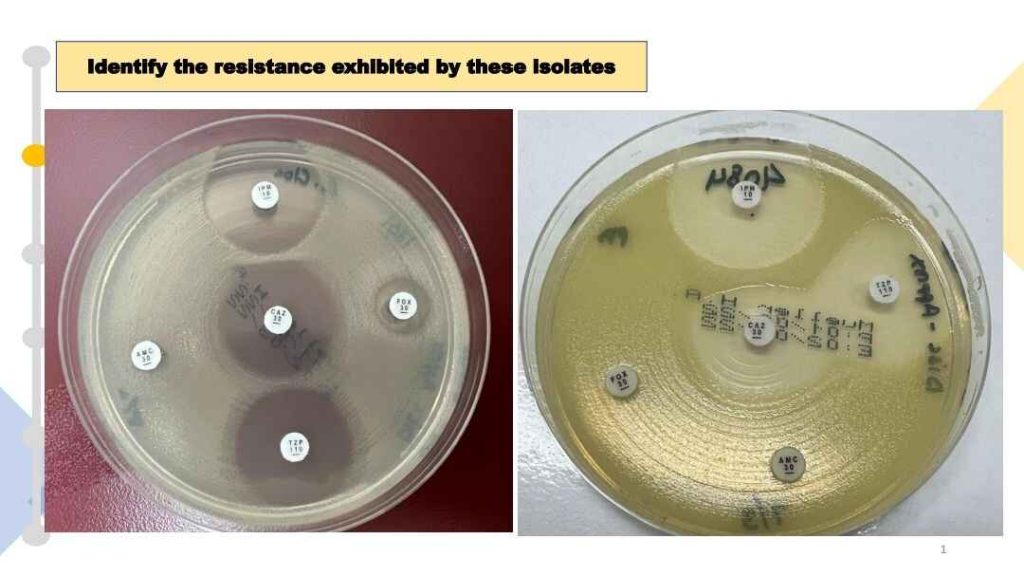
Plate 1 (Klebsiella pneumoniae - Left):
- Resistance Pattern: Strong flattening toward IPM (black arrow) indicates robust AmpC induction by imipenem. Weak/no flattening toward FOX/AMC shows weak induction by cefoxitin/amoxicillin-clavulanate.
- Interpretation: Isolate produces AmpC β-lactamase (strongly induced by carbapenems). No evidence of ESBL co-production.
Plate 2 (Escherichia coli - Right):
- Resistance Pattern: Potentiation (yellow arrow) between CAZ and TZP shows synergistic effect indicating ESBL co-production. Weak flattening toward IPM indicates AmpC presence.
- Interpretation: Isolate co-produces AmpC + ESBL.
Importance of Phenotypic Characterization
- Avoiding Treatment Failure: AmpC producers may test “susceptible” to ceftazidime initially but rapidly develop resistance. Using ceftazidime for the K. pneumoniae isolate (Figure 3, Plate 1) would fail due to AmpC hydrolysis.
- Detecting Co-Resistance: ESBL co-producers (Figure 3, Plate 2; Figure 9) require carbapenems, not β-lactam/β-lactamase inhibitors.
- Antimicrobial Stewardship: Prevents carbapenem overuse (AmpC-only isolates can use cefepime). Guides infection control (plasmid-mediated AmpC requires contact isolation).
Clinical Implications: Treatment Guidance
For AmpC-Only Producers
- Avoid: Ceftazidime, piperacillin-tazobactam, amoxicillin-clavulanate
- Use: Cefepime (stable against AmpC) or carbapenems (severe cases)
For AmpC + ESBL Producers
- Avoid: All cephalosporins and β-lactam/β-lactamase inhibitors
- Use: Carbapenems (meropenem) or novel combinations (ceftazidime-avibactam)
Outcome Impact: Correct phenotypic detection reduces mortality (sepsis from 40% to 15% with appropriate therapy).
Conclusion
The disc approximation test is a low-cost tool for detecting AmpC and co-existing ESBLs via flattening/potentiation patterns. Clinical laboratories should adopt disc approximation or CDT for routine AmpC screening and avoid relying solely on cefoxitin resistance due to high false positives. Phenotypic characterization optimizes antimicrobial stewardship and reduces carbapenem resistance emergence.
Further Reading
For a broader perspective on antibiotic resistance and the critical importance of preserving our last-resort antibiotics, see: Fighting Superbugs: The Race to Save Our Last Resort Antibiotics
Reference
Al Mamari AMK, Al Jabri Z, Sami H, Rizvi SGA, Chan MF, Al Siyabi T, Al Muharrmi Z, Rizvi M. Evaluation of six commercial and in-house phenotypic tests for detection of AmpC β-lactamases: is routine detection possible? JAC Antimicrob Resist. 2023 Sep 4;5(5):dlad101. doi: 10.1093/jacamr/dlad101. PMID: 37670936; PMCID: PMC10475971.